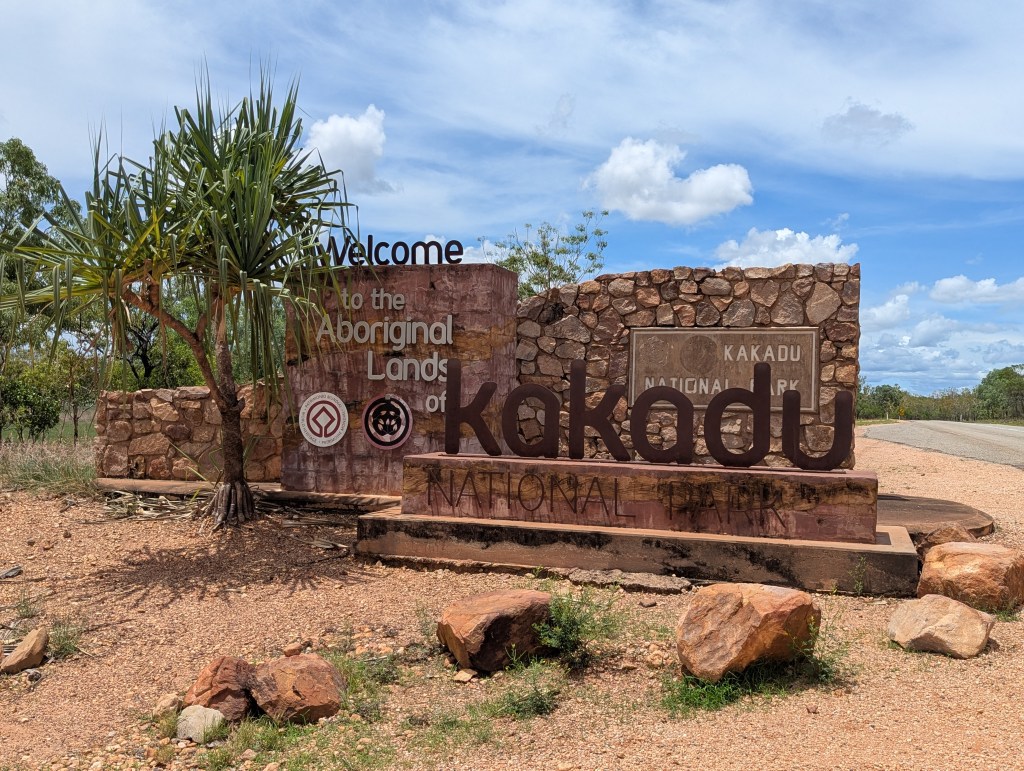
Our road trip from Darwin to Kakadu National Park was packed with wildlife, rock art, wetlands and unforgettable landscapes. Read on to discover more.
Day 1 – Darwin to Jabiru

We left Darwin soon after breakfast and reached our first stop just past the Adelaide River Bridge off the Arnhem Highway shortly after 9.00 a.m. The drive took about 50 minutes and although we were yet to reach Kakadu, we were excited to be taking a morning boat trip with Croc Spot Tours.

Our two hour cruise Croc Spot wildlife tour was superb as we not only saw lots of crocodiles but also learned a great deal about the animals and their habitat. Our guide Rex attached pieces of meat to a long pole which tempted the crocodiles to leap out of the water enabling us to have close up views of the jumping crocs. You might think that this sounds scary but we actually felt completely safe on board as there were metal railings attached to the sides of the boat for protection. Another unforgettable experience were the Whistling Kites which was a tremendous sight to see and hear. Croc Spot Tours. Several other companies operate on the river but Croc Spot offer smaller boats with a maximum of 20 people per trip, making them more intimate.

Leaving the excitement of our Croc Spot Boat Tour behind, it was then just a 20 minute drive to The Bark Hut Inn which is located just outside the western boundary of Kakadu National Park along the Arnhem Highway. This is the main road between Darwin and Jabiru and as there are few cafes within the National Park it was a convenient stop for us before entering Kakadu.
Obtaining Kakadu National Park Passes

Feeling suitably refreshed after our morning coffees it then didn’t take us long to reach the entrance gates to Kakadu National Park. Visiting Kakadu requires a park pass which allows entry to this stunning World Heritage listed park. Adult passes cost AUD$40 (£19.86) during the dry season (May to October) and AUD$25 (£12.40) in the wet season between November and April when visitor numbers are considerably lower. Passes are valid for 7 days and can be purchased online through the official Parks Australia website. Please note that individual passes are required and not one per car.
Mamukala Wetlands

Not far from the park entrance lies the Mamukala Wetlands where we followed a trail from the car park to the bird hide which overlooks a seasonal floodplain. From the shelter of the hide, we watched a variety of waterbirds feeding and resting across the wetlands with egrets, herons and other species scattered through the shallow water.

The quiet setting made it easy to observe the birds up close and for us to appreciate the importance of Mamukala as a haven for wildlife, especially during the wetter months.
Where we stayed:
Mercure Crocodile Hotel, Jabiru

By late afternoon we had reached Jabiru and checked into the Mercure Crocodile Hotel, famously shaped like a crocodile due to its unique design. Guests enter through its open mouth immediately setting an unusual tone. Our room was accessed via one of the crocodile’s massive feet adding to the sense of novelty. Beyond its quirky exterior, the hotel offered comfortable accommodation and a convenient base for exploring Kakadu National Park, making it both a memorable and practical choice for our stay. We enjoyed a leisurely dinner in the hotel restaurant rounding off our first day in Kakadu.
Day 2 – Ubirr and Yellow Water

After breakfast at the hotel, we drove about 20 minutes to Cahills Crossing, where we watched a car carefully navigate the partially submerged road (a special permit is required to cross). This crossing is famous for spotting crocodiles feeding at certain times of the year as tidal waters push fish upstream over the crossing. Sadly we didn’t spot any when we were there.

We then continued on to Ubirr, following the trails to the ancient rock art sites and lookout points. Some scrambling over rocks was required but the views and the artwork made it well worth the effort.


Cooinda Yellow Water Cruise

Later, we drove on for a further 45 minutes to Cooinda and joined the two-hour dusk cruise from the Yellow Water Cultural Centre. This was an absolute highlight of Kakadu.

We saw crocodiles everywhere, along with kingfishers, egrets, and the most beautiful lotus water lilies. The live commentary was excellent and I consider this cruise to be a ‘must-do’ whilst exploring Kakadu. Cooinda Yellow Water Cruises

Day 3 – Rock Art and Culture

The morning began with a drive to Burrungkuy (Nourlangie) where we completed the main walk to the Aboriginal rock art sites before continuing on to the lookout point. The walk involved quite a bit of scrambling over rocks and took around two hours in total making it moderately challenging but extremely rewarding.

We then returned to Cooinda to explore the Warradjan Cultural Centre (free admission) which provided an insight into Aboriginal culture and life in Kakadu. (Please note that photography is not allowed inside the centre).

Later, we drove along a short dirt road to Nanguluwurr, where we completed an easy 4km walk through woodland to more rock art sites. It started to rain on the way back, but it was warm and actually added to the atmosphere! Dinner was spent sitting around the pool at Aurora in Jabiru.
Day 4 – The Journey Back to Darwin

We planned to visit Maguk waterfall first, but after driving some distance along an unpaved road that had become flooded we decided to turn back. Instead, we visited the Bukbukluk Walk and Viewpoint, an easy 800m walk from the car park.

Next was Upper Ikoymarrwa Falls (Rock Hole). The walk was moderate and very rocky but worth the scramble for its picturesque setting.

We then drove to the southernmost entrance to Kakadu where it meets the Stuart Highway. Lunch was at the Lazy Lizard Tavern in Pine Creek which even had its own live lizard relaxing on one of the tables.

Whilst in Pine Creek, we visited the Rail Museum ($5 entry, free for U.K. National Trust members). Though small, it was worth a visit, and we even clambered inside one of the trains.

On the drive back to Darwin, we stopped at Adelaide River to view a historic Commonwealth Railways engine, a fitting final stop on our journey.
And there you have it – my three day guide to Kakadu National Park. It’s an unforgettable destination, rich in wildlife, culture and dramatic landscapes and I believe should be on everyone’s Top End itinerary.
If you have enjoyed this post you may also like:
Darwin Northern Territory Guide: What to See, Where to Go and Top Experiences
Top Things to Do in Port Douglas and the Daintree River Region
We were guests of Croc Spot Tours and Cooinda Yellow Water Cruises and as always all views and opinions are entirely my own.


 Love Travelling Blog
Leave a reply to Little Old World Cancel reply