We took an early morning flight from London Heathrow to Basel airport, officially referred to as Euro Airport Basel Mulhouse Freiburg. The airport lies in France on the south western edge of the Black Forest, close to the borders with Switzerland and Germany.

Passengers are able to depart from either the Swiss or French side of the airport with car hire being available from both, with this being considerably cheaper at the time of booking from the French section. We collected our hire car from Hertz and after loading the luggage and setting our SatNav, were soon on our way to Freiburg. This German city is approximately a one hour drive from Basel airport with most of the journey being along the A5 autobahn.

We’d arranged to stay at the historic Park Hotel Post located just a couple of minutes walk from the pedestrianised old town. An added bonus of the hotel is that it has an underground car park. A literature theme runs through the hotel as authors and artists have visited over the years. After enjoying a refreshing welcome drink we were then ready to meet Klaus, one of Freiburg’s walking guides who would be showing us around the beautiful old town.

Our 90 minute walking tour of the university town started with a short walk to the city’s reconstructed medieval old town which is characterised by its picturesque narrow gutters (bächle). The streets have narrow water gullies between the road and pavements that are fed by the Dreisam river and extend for 15.5 km. In medieval times the water provided local tradespeople such as tanners with water and the gullies were also useful for fighting fires.

Nowadays, they are a delightful feature popular with young and old as children adore pulling brightly coloured wooden boats through the gullies tied to a piece of string whilst adults can sit and paddle. A local legend has it that if you accidently step into a Bächle you will end up marrying someone from Freiburg.

Soon we arrived at the picturesque main square (Münsterplatz) which is dominated by the 13th century medieval Minster which took 300 years to build. Despite heavy wartime bombing in 1944 around the square, the Minster miraculously suffered only minor damage.

We entered through its main door which boasts 418 intricately carved figures dating from the 1200’s. The interior is equally beautiful with its stained glass windows depicting medieval guilds including tailors scissors and bakers pretzels. Also of particular note is the Romanesque altarpiece and four pipe organs.

Back outdoors, we admired the historic buildings lining the Münsterplatz which had been painstakingly reconstructed after the Second World War. The elegant 18th century Baroque Wentzingerhaus located on the southern end of the square remained unscathed and is now in use as the city museum.

Moving on, our guide then took us to view the city’s two medieval gates. The Schwabentor was constructed in the mid 13th century with its tower formed of three floors constructed from red sandstone and its staircase tower and half timbered extension dating from the 16th century.
Next we viewed the Martinstor, the older of the two city gates lying on the south west side of the old town. This gate has protected Freiburg since 1202 with the lower third of its tower being original whilst the upper floors date from the early 20th century.

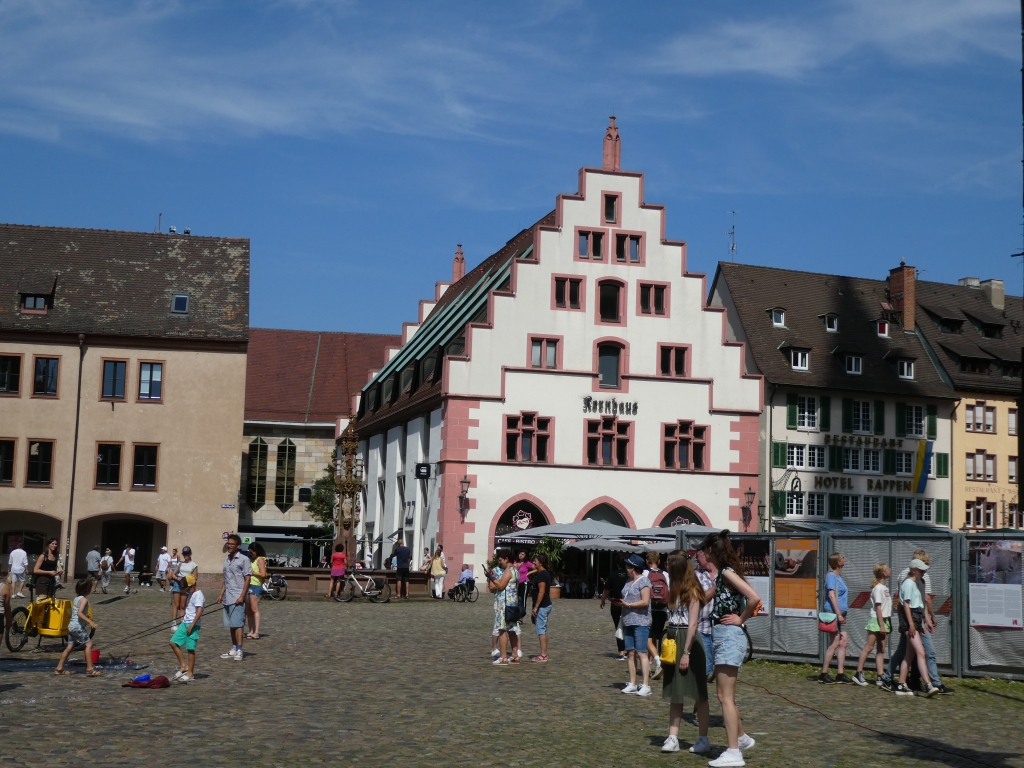
Also of note in the old town are the Rathäuser, Freiburg’s old and new town halls which sit side by side on Rathäusplatz. The old town hall is built in Renaissance style and originates from the late 1550’s. Adorning the front of the building are the coats of arms of the city’s ruling families. The new town hall next door comprises two Burgher houses which have since been joined together.

Continuing, we then stepped inside the 19th century Markthalle which was formerly a printing works and now serves as a food court offering cuisine from all corners of the world. The benefit of this arrangement is that everyone can order their favourite dishes whilst still eating together.

Taking the guided walking tour had been very enjoyable and provided us with an excellent overview of Freiburg’s old town enabling us to discover so much more than if we had just been wandering around on our own. Freiburg Walking Tour.

We then visited the Augustiner Museum located in a former Augustinian monastery and displaying works from the Middle Ages through to the Baroque period. The main hall is impressive with its collection of original statues and beautiful stained glass windows brought from the neighbouring Freiburg Minster.

We were fortunate to have timed our visit whilst an organ recital was taking place, the melodic sounds of which we were able to hear from several of the museum’s galleries. On display upstairs were paintings by 19th century artists favouring country scenes whilst down in the basement a temporary exhibition was taking place featuring rural Black Forest scenes and traditional costumes. Augustiner Museum.

It was then time to sample some of the local wines so we headed to the centrally located Alte Wache on the Münsterplatz, formerly the city’s main guard house and quarters of the Austrian guard. Constructed in 1733 as part of the military reinforcements the building is now home to the House of Baden Wines.

There’s a popular large outdoor terrace, wine tasting room and shop. We’d arranged to sample some local wines as the Baden region is Germany’s third largest wine growing region due to its Mediterranean climate and good soil producing high quality wines.

Our visit started off with a Kalte Sofie, a refreshing iced wine drink made to the Alte Wache’s own recipe that has a consistency somewhere between a sorbet and a glass of wine resulting in a unique taste ideal for a hot summer’s day. Eva, our guide then led us through tastings of several Pinot Noirs from the local area. Alte Wache.

After our wine tasting we were then ready to sample some local cuisine so we headed to the Großer Meyerhof restaurant just a short walk away. We’d reserved a table indoors but as it was such a warm evening decided to sit outside on the terrace. Grosser Meyerhof

Whilst quenching our thirst with glasses of local beer we ordered regional specialities of roasted liver and pork shoulder served with vegetables and side salads which both tasted delicious.

We then rounded off our first day in the Black Forest with a late evening stroll through the Dreisam and Wiehre districts, passing locals relaxing on stones along the river.
If you have enjoyed this post you may also like:


 Love Travelling Blog
Leave a reply to Egor Zimowski Cancel reply