We drew back the curtains to a bright, sunny morning, just perfect for our planned excursion over to Liberty and Ellis Islands. The nearest subway station is at Whitehall Street – South Ferry just a short walk from the ferry terminal in Battery Park.

Fortunately, we didn’t have to join a lengthy queue to purchase tickets as we were in possession of a New York CityPASS which entitles holders to visit five top attractions in the city with a 40% discount. Standard adult tickets with Statue City Cruises cost $25 (£19.76). On arrival in New York two days earlier we had pre-booked timed tickets for the 11.00 a.m. ferry. Tickets also include entrance to the Statue of Liberty National Monument and the Ellis Island Museum of Immigration.

Visitors should arrive a minimum of 30 minutes prior to departure as it takes quite awhile to pass through the security screening before being able to board the boat across to Liberty Island. Boats are spacious with an indoor deck with snack bar downstairs and steps leading up to a partially covered deck and an open deck upper level. We went up to the top deck which is the best vantage point for views of the New York skyline and the Statue of Liberty. Within 15 minutes we had landed on Liberty Island where we were able to spend as long as we wished before boarding another ferry to nearby Ellis Island.

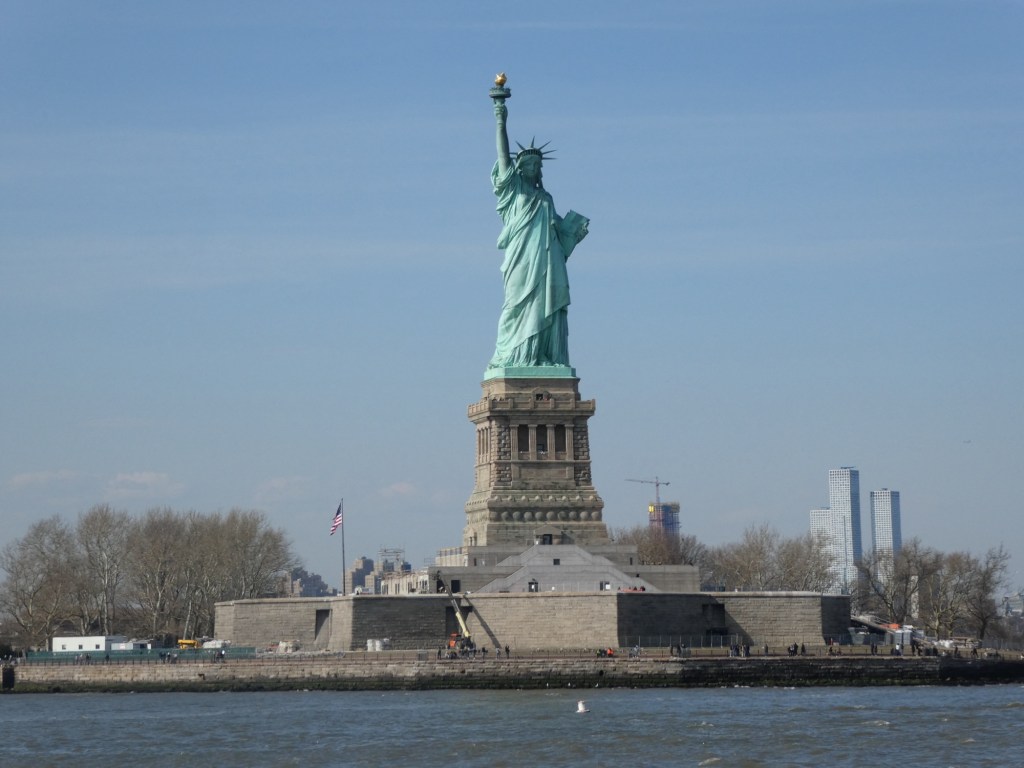
Standing in front of the iconic Statue of Liberty is memorable both for its appearance and colossal size measuring 305ft (93m) and weighing 223 tonnes. The statue commemorates the friendship of the peoples of the United States of America with those of France. Designated a UNESCO World Heritage Site it symbolises the freedom and democracy of the United States. The statue represents a woman holding a torch in her right hand and a tablet bearing the adoption date of the Declaration of Independence (4th July 1776) in her left. A limited number of tickets are available each day to access the top of the pedestal and also the crown.

In addition to admiring the magnificent statue, from the island there are splendid views looking back across to Manhattan. Next, we wandered across to the Statue of Liberty Museum which has been open since 2019. The museum is divided into three interactive galleries, an immersive theatre, an engagement gallery and the inspiration gallery.

The museum explores the design and construction of the statue and earlier designs submitted. The statue is predominantly made out of copper, with the amount used enough to make 30 million pennies.

On display is the original torch which was held high for nearly 100 years until it was replaced in 1986. Glass walls surround the torch enabling visitors to enjoy panoramic views of Lady Liberty and the Manhattan skyline.

The museum has been designed to incorporate an accessible rooftop affording more opportunities take in the stunning views but this was closed at the time of our visit due to the windy conditions.
Ellis Island Immigration Museum

It was then back on the ferry for the short journey across to Ellis Island. Stepping off the ferry, we took the same route as more than 12 million immigrants had done whilst embarking on their journey to a new life. Ellis Island was the nation’s chief gateway during the years 1892-1954. Following restoration in the 1980’s the building re-opened as the National Museum of Immigration.

With the aid of interactive audio guides we were able to learn about the stories of families who passed through the registry rooms chronicling Ellis Island’s role in immigration history. The Great Hall has been beautifully restored to its original appearance and this was where immigrants who had endured cramped conditions on board ships would have passed through to register their arrival and have their documents thoroughly checked.

Seated on hard, wooden benches they would gradually shuffle forwards often waiting long periods of time to be attended to. Immigrants also had to pass medical examinations with some rejected as seen as unfit to enter the United States. This could have been because they were unfortunate to become sick on their journey resulting in them being deported and their hopes for a new life dashed.

The self guided tour took us through the baggage room, sparse dormitory with its tiny bunks where immigrants families had to sleep whilst their cases were being reviewed whether it be due to illness or lack of paperwork.

Visiting Ellis Island is a moving experience and with an on-site American Family Immigration History Centre visitors can search for their ancestors utilising the vast archive to examine immigration documents and find connections to their ancestors and heritage.

By the time we were ready to return to Manhattan a ferry was just approaching which took us back to our departure point in Battery Park. I highly recommend adding a visit to Ellis Island to your New York itinerary and to allow a minimum of three hours to make the most of the experience.
Trinity Church, Lower Manhattan

Back in Lower Manhattan we called into a deli for a late lunch before popping into Trinity Church on Wall Street for a look around. We had admired the church from the outside earlier in our stay but as it was a Sunday it was closed to visitors whilst a service was taking place.

Sitting between city skyscrapers, Trinity Church has a deep history as in 1697 a little over 70 years after the Dutch settled in New York as a trading post known as New Amsterdam, the church was granted a charter by King William III of England. The present building is the third on the site and was consecrated in 1846 and designed by the British architect Richard Upjohn in 19th century Gothic Revival style. Not only is the interior of the church beautiful but the churchyard deserves a wander too as it contains the graves and monuments of many politicians, war heroes and influential businessmen making it one of the most famous graveyards in New York.
Federal Hall

Leaving there, it was just a short walk along Wall Street to Federal Hall which we found to be covered in scaffolding with its main entrance closed and visitors directed to a temporary entrance at the rear. Federal Hall is a national monument and was where George Washington took the oath of office as the first President of the United States and the site of the first Congress and Supreme Court. The building then served as part of the U.S. Sub-Treasury and since 1972 has functioned as both a museum and memorial. Entrance free.

Internally it features a magnificent main rotunda 6ft (18m) in diameter with balconies on four sides. The wall of the rotunda contains four sections of colonnade, each of four columns.
Roosevelt Tramway

Leaving Wall Street behind we then hopped on a subway to 59th Street Upper East Side as our plan for the late afternoon was to take a ride on the Roosevelt Tramway which crosses the East River from Manhattan to Roosevelt Island. The tramway or gondola as I would refer to it, is included in the New York City metro card and costs the same as a single ride on the subway, $2.90 (£2.29). The four minute journey carries up to 110 passengers every 15 minutes and was installed in 1976 followed by the F train subway line in 1989.

Taking a ride on the tramway is fun as it reaches a height of 259ft (76m) above the river affording excellent views in all directions from the gondola windows.

Roosevelt Island is located in the middle of the East River and being just 2 miles long (3.2 km) is easily walkable. On leaving the tramway station we called into the Roosevelt Island Historical Society Visitor Centre which lies adjacent to the tramway terminus. This historic building was once the city kiosk for the trolley car service that used to run over the Queensboro Bridge to the island from 1930-1957 before buses replaced it.

From the visitor centre we headed to the river and walked through Southview Park along the embankment turning leftwards to the south. This stretch of promenade is very peaceful and with wooden sun loungers to relax on and splendid views back across to Manhattan it was the perfect way to relax.

Strolling further we came to the remains of a smallpox hospital which is now referred to as the ‘Renwick Ruins’. The isolation hospital was built on the island in 1856 and was the first hospital in the United States to admit patients with the highly contagious smallpox disease.

Until its closure in the 1950’s the hospital treated 7,000 patients a year. The building then fell into a state of decay and disrepair until it was saved by the Landmarks Preservation Commission in the 1960’s who shored it up to prevent total collapse.

Continuing to the southern tip of the island we reached the Franklin D. Roosevelt Four Freedoms Park which opened in 2012 as a memorial to the former president. The park celebrates the four freedoms that Roosevelt spoke of in his 1941 State of the Union Speech these being freedom of speech, freedom of worship, freedom from want and freedom from fear. Rather than retrace our steps all the way to the tramway, we hopped on one of the red buses which loop around the island stopping at both the tramway and subway stations.

Later in the evening we took a walk around Times Square admiring the bright lights of this vibrant part of the city. The end of another lovely day exploring New York City.
If you have enjoyed this post you may also like:


 Love Travelling Blog
Leave a reply to Lana Cancel reply