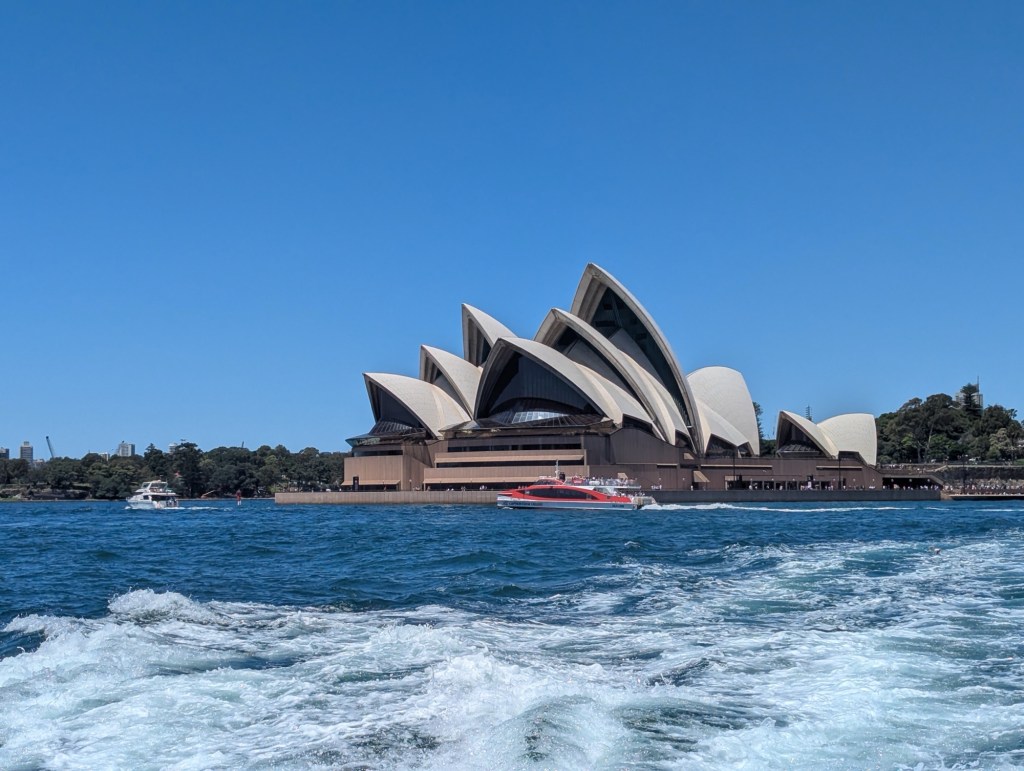
The Sydney Opera House is one of Australia’s most iconic buildings and is located on the headland of Bennelong Point. If you’re curious about its history and what it looks like inside then consider taking a one hour tour as we did.

We started off the day with the 9.45 a.m. guided tour, standard admission AUD$45 (£22.50) which operate frequently but I’d recommend booking in advance to avoid disappointment. We made use of our Go City Pass which includes the Opera House on their Sydney cards, offering savings.

The meeting point for tours is at the Welcome Centre located on the underground level near the Opera Bar. After checking-in we were introduced to our guide who handed out headphones to enable him to talk to the group of 35 without needing to shout and to ensure that no-one was struggling to hear.

Whilst touring the building we learnt lots of interesting facts about its construction which was scheduled to take four years, at a cost of AUD $7m (£3.5m) but ended up taking 14 years rising to a staggering AUD $102m (£51m) when it eventually opened in 1973. The Opera House was included on the UNESCO World Heritage List in June 2007 placing it alongside the Taj Mahal, the ancient Pyramids of Egypt and the Great Wall of China as one of the most outstanding places worldwide.

The Opera House’s roof is constructed of 1,056,000 glazed white granite tiles imported from Sweden. Despite their self-cleaning nature, they are still subject to maintenance and replacement. Its interior is composed of pink granite mined from Tarana, New South Wales and white birch and brush box plywood supplied from northern NSW.

The theatres are contained in a series of large shells, modelled on a dissecting globe. The Concert Hall and Opera Theatre are contained in the largest shells whilst the other theatres are located on the sides of the shells. Free outdoor public performances are occasionally staged in front of the monumental steps that lead up to the base of the main set of shells. Restaurants and a gift shop are also housed within the complex.

As well as many touring theatre, ballet, and musical productions the Opera House is the home of Opera Australia, the Sydney Theatre Company and the Sydney Symphony Orchestra. We were able to view most parts of the building but as rehearsals were taking place by the Sydney Symphony Orchestra in the concert hall and sets were being prepared for a ballet in another auditorium photography was only permitted in the main concourse areas. I would definitely recommend joining one of the tours as this provides a behind-the-scenes look at how the Opera House operates in addition to viewing the various theatres.
Exploring the historic Rocks District

Afterwards we enjoyed cappuccinos in one of the cafes overlooking Circular Quay before wandering around the quay to the historic Rocks district from where we had more spectacular views of both the Opera House and the Harbour Bridge.
The Rocks Discovery Museum

As the oldest neighbourhood in the city, The Rock’s cobblestone streets are home to many heritage and former warehouse buildings, including the oldest house in Sydney, Camden Cottage, which was built in 1816. It’s a lovely place for a stroll and whilst wandering along Kendall Lane we came across the The Rocks Discovery Museum which is free to visit and is housed in a restored 1850’s sandstone warehouse. The museum’s galleries are spread across two floors and tell the story of The Rocks from pre-European days to the present. Here we learnt about the district’s traditional custodians, the establishment of the English colony and the time when sailors, whalers and traders made The Rocks their home.
Sydney Observatory

Leaving there we walked around the foot of the Harbour Bridge before climbing the hill to the Sydney Observatory located on Upper Ford Street at Millers Point. The Observatory offers free admission and is open from Thursday to Sunday each week.

The Sydney Observatory is positioned on the highest point overlooking the harbour. The interior features planetary displays alongside historical astronomical and weather monitoring achievements in a number of small rooms all containing original fireplaces.

Located outdoors is the Observatory Rotunda from where we enjoyed panoramic harbour views. It’s quite a hidden gem but definitely worth the uphill walk to visit.
Sydney Tower Eye

Continuing on our way, we headed to the Barangaroo metro station so that we could take in the views from the Sydney Tower Eye located a five minute walk from St James station. Entrance to the Tower Eye is accessed from Level 5 of the Westfield Centre close to the Queen Victoria Building. Standard admission is AUD$40 (£20) and is included in the Sydney Go City Pass alongside the Opera House and other Sydney attractions.

A high speed lift took us up to the observation deck which stands 250m above street level. As it’s the highest point in Sydney there are stunning city views and it is a great place to get your bearings as we were able to see which parts of Sydney we had already visited and what else lay in store.
St. Mary’s Cathedral

Back at ground level we walked across to nearby Hyde Park which is home to the Catholic Cathedral of St. Mary.

St Mary’s was built on the site of the first Catholic Chapel in Australia. Constructed in local sandstone, the Gothic Revival style of its architecture is reminiscent of the great medieval cathedrals of Europe. It was fascinating to walk around on our own but if you time your visit for a Sunday afternoon then free guided tours are also available.
Manly

After visiting the cathedral we strolled back through the park before popping on board the metro back to Circular Quay to catch one of the frequent ferries across the harbour to Manly. Our ferry was non-stop, taking just 20 minutes to reach the popular seaside resort. By the time we arrived it was mid-afternoon so we called into one of the beachfront cafes for drinks after first looking in some of the high street shops.

Feeling refreshed, we set off again, continuing along the Pacific Ocean shoreline quite a way before heading across town to the more sheltered harbour side. This was my favourite part of Manly as the coastal path took us alongside several secluded coves with lots of small boats bobbing up and down in the harbour.

Apart from a few joggers and dog walkers we mostly had the path to ourselves and if we’d started the trail earlier in the day we would have continued on further to the Spit. Signs along the footpath alerted people to watch out for little penguins, this we did, but sadly there were no sightings that day.

We caught a bus back to the centre of Manly where we had dinner in a cosy pub before returning to our hotel for the night.
If you have enjoyed this post you may also like:


 Love Travelling Blog
Leave a reply to Monkey’s Tale Cancel reply