Alcatraz is a small rocky island located one and a quarter miles out in San Francisco Bay. It was one of America’s most feared prisons that no criminals wanted to be sent to. Times have changed as a visit to Alcatraz is now one of the most popular city attractions.

We booked tickets through Alcatraz City Cruises, who are the only boat company to land on the island with other operators just coming up close as part of a harbour tour. Standard adult tickets cost $42.25 (£34) and these need to be pre-booked in advance for a specific time. Boats operate daily from Pier 33 on the Embarcadero with regular sailings starting from 8.40 a.m. We opted for the 10.10 a.m. departure and sat indoors as it was a miserable, wet morning.

It was just as well that we had taken a harbour cruise earlier in our stay when it was sunny as visibility was so poor that it was impossible to even make out the Golden Gate Bridge on our 15 minute journey over to Alcatraz. Food and drink are not allowed on the island except for the dock area but snacks can be purchased and consumed on board the boat. Alcatraz Island is maintained and operated by the National Park Service with optional guided tours available each day.

Visitors disembark next to the guard tower where a National Park ranger greets each boat with a short introduction to the former prison. This is followed by a short video in the adjoining theatre which is worth watching as it provides an overview of the island. We then headed up a slope to the cell blocks which were used as a federal prison between the years 1934 to 1963 to take a self-guided tour.

We entered the main cell block building in the same way as the prisoners would have done, starting in the receiving area where the new inmates were issued with prison clothes and basic necessities.

From there we moved through to the communal shower area where we picked up our audio guides which are available in numerous languages. The Alcatraz audio tour is narrated by former prison guards and inmates, providing visitors with an authentic experience from those who actually experienced it.

Listening to our audio guides we learned that the prison opened in 1934 and was designed to house the most notorious criminals in the country. During its 29 years of operation it housed bank robbers and murderers including Al Capone, Robert Frank Stroud (the Birdman of Alcatraz) and Machine Gun Kelly.

The prison was known as ‘The Rock’ due to its location on a small rocky island in the centre of the bay. Alcatraz was a maximum security prison that housed many criminals who would not conform in other prisons and who were considered violent and dangerous.

They were moved here as it prevented them from escaping, although there were 14 failed attempts by 36 different prisoners. 23 inmates were caught, 6 were shot and killed, two drowned and five unaccounted for but thought to have drowned.

The audio tour lasted 30 minutes and guided us through the cell blocks and isolation unit where we viewed the spartan conditions the prisoners had to endure with just a bed with a thin blanket and no pillow, a towel, sink and toilet. The majority of cells were inward facing lacking natural light with inmates only experiencing daylight and fresh air during their short spells out in the exercise yard.

After viewing row upon row of cell blocks we continued through the library and into the large refectory and kitchen area which was displaying a breakfast menu for inmates of porridge, toast, cereal or scrambled eggs which probably wasn’t as appetising as it sounded.

On completion of our cell block tour we returned our headphones and had a look around the gift shop before strolling around the exterior of the island. Unfortunately, the wind and rain had increased so after a quick walk we took the next boat back to Pier 33. Visitors are permitted to return on any service subject to space being available and I would allow approximately three hours for the round trip and tour of Alcatraz.

On returning to Fisherman’s Wharf we headed straight to Boudin at the Wharf to warm up with bread bowls of Clam Chowder. At the beginning of our trip we had enjoyed this New England delicacy at their branch on Pier 39 so for a change we called into their flagship cafe/restaurant slightly further along the promenade.

There’s a large observation window visible from the street and within the cafe where you can watch the bakers creating batches of their award winning sourdough and just by chance we managed to get a table up against the viewing area.

We were both cold and wet and the hot bowls of soup warmed us up nicely before continuing our sightseeing with a visit to the historic Cable Car Museum located at Nob Hill. I always enjoy a visit to a transport museum and this excellent museum is free to visit and contains a collection of historic cable cars, mechanical displays, photographs and memorabilia.

Cable cars started to operate in San Francisco from 1873 and through information boards and old cars we learnt about the cable cars history, expansion and more recently how it was saved from being permanently closed down.

The building is actually a working museum as it is located in the Washington/Mason cable barn powerhouse where visitors can see the mechanism working the cable cars with the huge engines and winding wheels. These large sheaves and cable lines enter the building through a channel under the road that powers the cable cars. The cable cars are driven by the grip person whose job requires strength and balance to control the speed of the tram by using a large lever that controls how tightly the cable car grips the moving cables under the road.

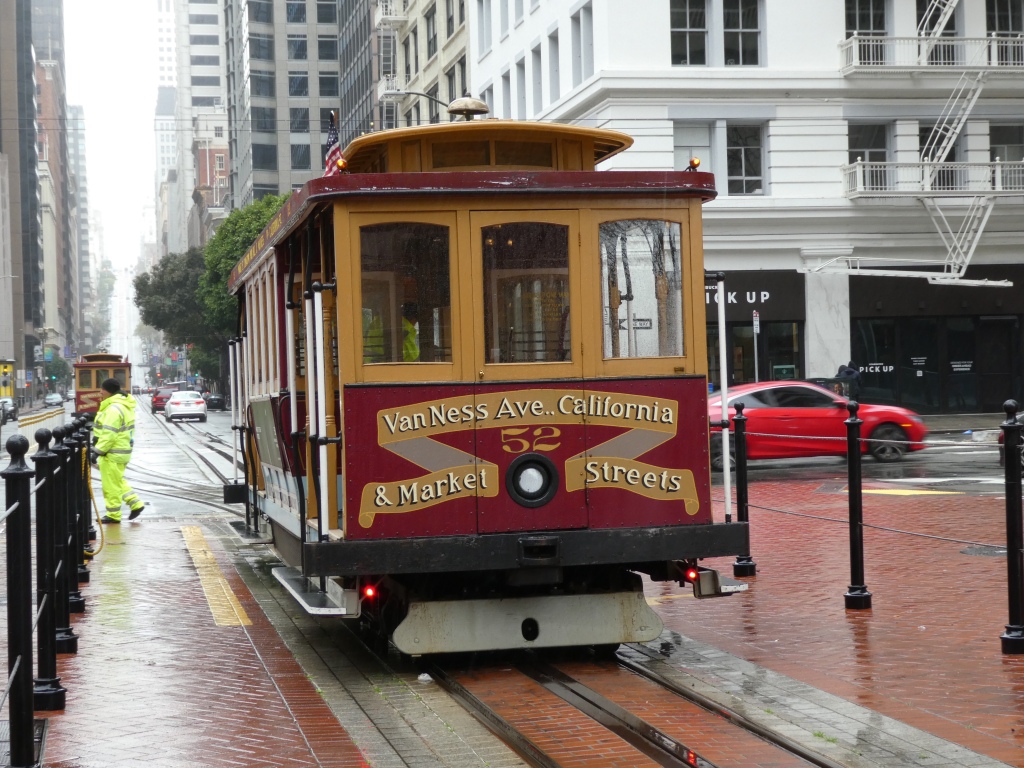
Currently there is a fleet of 28 Powell Street cable cars and 12 California Street cable cars with a maximum of 27 out on the streets at any one time. The single ended Powell Street cars are the older of the two types now in service and have one grip end. Whereas the double ended California Street type cars were developed later and are fitted with a control lever at each end eliminating the need for the use of a turntable at the end of the lines.

It’s a splendid museum and after visiting, we took our first ride from Nob Hill on one of the California Street double ended cars to the end of the line. This route seems less popular with tourists as the hills it goes along are not quite so steep so if you are short of time and don’t want to queue for the Hyde Street line this is a good alternative.

The rainstorm seemed never ending so we called into the San Francisco’s Ferry Building which is one of the city’s most famous landmarks and is located along the Embarcadero at the end of Market Street.

Its main concourse has been tastefully transformed into a marketplace lined with gourmet deli’s, coffee shops and craft stalls. We bought cups of coffee from Red Bean Coffee and sat by the rain splattered windows looking out across the bay.

To conclude our lovely stay in the city we decided to go shopping around Union Square and looked in Saks Fifth Avenue, Bloomingdale’s and Nieman Marcus. The latter was my favourite as this luxury department store had the most beautiful rotunda topped by a stained glass dome. The rotunda and ceiling are remnants of a former department store known as the City of Paris.

The stained glass dome depicts a ship, the Ville de Paris which brought the founders of City of Paris to San Francisco in 1850. The store closed in 1972 and was eventually sold to Nieman Marcus.

We ended our day in true American style with tasty burgers and chips from Shake Shack before returning to our hotel to pack and prepare for the second part of our Californian adventure. We’d adored our visit to San Francisco and looked forward to discovering what Los Angeles had to offer.
If you have enjoyed reading this post you may also like:
Riding the Roosevelt Tramway and walking the High Line, New York City
During our stay in San Francisco our visit was supported by San Francisco Travel and as always, all views and opinions are entirely my own.


 Love Travelling Blog
Leave a reply to Little Old World Cancel reply