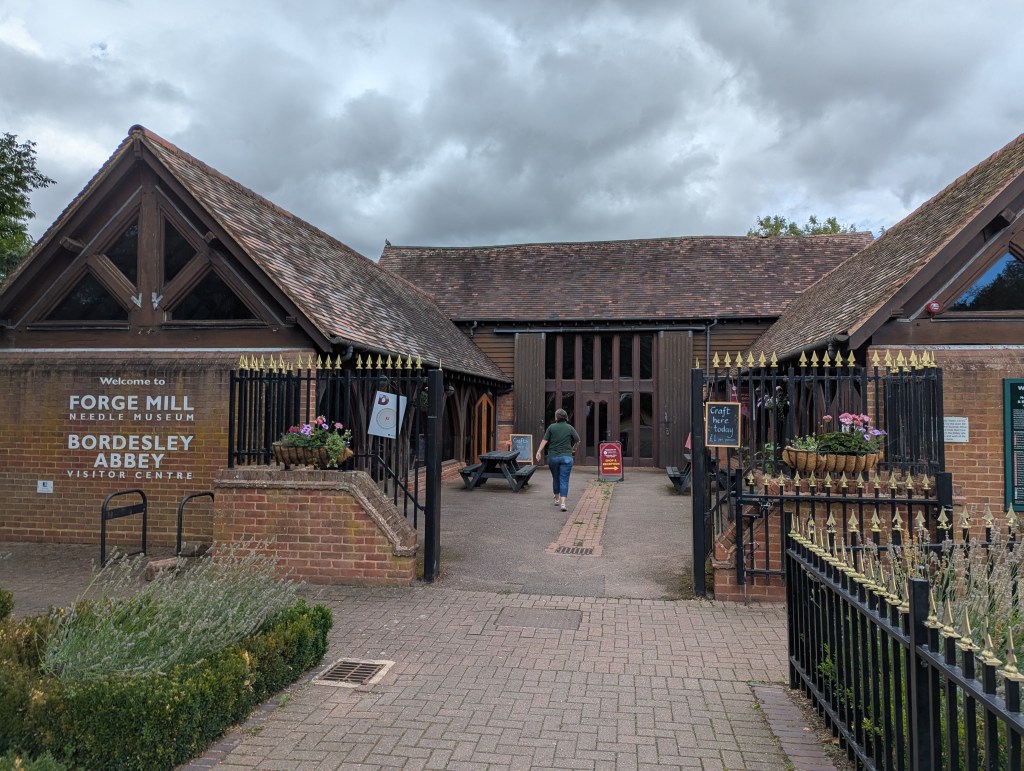
Why visit Forge Mill Needle Museum?

Forge Mill in Redditch is an unusual and fascinating place to visit. This historic site illustrates the rich heritage of the needle and fishing tackle industries. Models and recreated scenes provide a vivid illustration of how needles were once made, and how Redditch once produced 90% of the world’s needles. At its peak in the 1870’s, the Redditch area (in which Forge Mill was one mill) produced about 3.5 billion needles per year.
Getting to Forge Mill

The historic Forge Mill Needle Museum is easily accessible from the M42 motorway, simply exit at Junction 2 and then follow the A441 south towards Redditch. Once in the town, the museum is clearly signposted and benefits from a large, free car park. Standard admission £6.95.
Exploring the Museum

The museum takes a humble needle and demonstrates how central it once was from its connections to health, clothing, medicine, industry and daily life. The ground floor led us into what was once the scouring (polishing) mill.

The purpose of this building was for cleaning, polishing and preparing steel wire and needles. The site was originally an iron forge, but by 1730 had been adapted for needle related processes. Much of the original Victorian era water powered machinery was still in place which was good to see. A sign indicated that the Forge Mill scouring mill is the only preserved water powered scouring mill of its kind in the world.

We clambered up a wooden staircase leaving the heavy machinery behind on the ground floor to view exhibition galleries further up the building. On the middle floor there was a display about Victorian homemaking: sewing boxes, vintage embroidered items, advertisements and tools of domestic needlecraft. In one alcove, an example of a 19th century workshop showed men and women bent over benches working with machines and hand tools.

One exhibit traced 30 separate processes in the manufacturing of a needle from wire drawing to pointing, hardening, tempering and polishing. Another corner housed unusual needles – giant needles for mattresses, sewing needles used in industrial looms, surgical, micro‑needles and even decorative needles.

The mill didn’t just produce needles but also fishing hooks and needle cases. The display of Victorian needle boxes, ornate tins and cases caught my attention as I recognised some of the old tins and needle packets from my Grandmother’s sewing box.

After heading up yet another flight of steps we reached the top floor which is home to an extensive collection of needle and fishing tackle items. This is believed to be the largest public collection of its kind in the country. Rows of cabinets contained intricate pieces including tiny surgical needles, antique darning and tapestry needles. I found a series of progressive shapes representing each step of the needle production process from raw wire to pointed tips fascinating. A label indicated that to create a single needle it had to pass through multiple stages necessitating many hands and many tools.
The Waterwheel & Machinery

The waterwheel powered the original machinery including scouring / polishing machinery for needle manufacture. Also, in earlier times, when the site was a forge, machinery for forging would have been driven by water power. During the time of our visit the waterwheel was undergoing repairs and was sadly not operating. When working, the waterwheel converts the falling water into mechanical energy to power the machinery inside the mill.
A Walk Among Ruins: Bordesley Abbey

Adjacent to the mill, just a short stroll across grassy slopes, lie the remains of Bordesley Abbey, a 12th-century Cistercian order. The abbey visitor centre (housed in a reconstructed barn) presents artefacts, excavation finds and the abbey’s history from its founding, daily life to dissolution under Henry VIII in 1538. Visitors can stroll among the stone remains which are interspersed with information boards explaining how the monks diverted water, drained marshes and built ponds.
What a fascinating morning we’d spent in the needle museum. Next time I need to sew a button back on I’ll think back to all the skill and dedication required in days gone by to produce these tiny household necessities.
If you have enjoyed this post you may also like:
Exploring Stockport and its Hat Works
I was a guest of Forge Mill Needle Museum and as always, all views and opinions are entirely my own.


 Love Travelling Blog
Leave a reply to kagould17 Cancel reply