What is Japan Tag?
Japan Tag Düsseldorf (Japan Day) is Europe’s largest celebration of Japanese culture and Japanese–German friendship. Every spring, hundreds of thousands of visitors travel to the city for a festival that blends traditional Japanese culture with modern pop culture in a way few other events manage successfully.

The festival spreads across the Rhine promenade, Burgplatz, the Altstadt and the city centre itself. What makes Japan Tag unique is that it never feels contained inside a convention hall. The entire city becomes part of the experience. Traditional tea ceremonies take place only streets away from anime dance performances. Martial arts demonstrations happen beside food stalls selling takoyaki and ramen. Cosplayers pose for photographs while taiko drummers perform nearby. The scale of the event is enormous, yet it still feels personal because Düsseldorf already has a deep connection with Japan long before the festival begins.
Why Düsseldorf?
Most visitors are surprised to discover just how Japanese Düsseldorf already feels. The city is home to the third largest Japanese community in Europe, after London and Paris and by far the largest in Germany. For decades, Japanese companies established their European bases there, creating a permanent Japanese cultural presence that transformed part of the city into what is now known as “Little Tokyo.”

Centred around Immermannstraße near the main railway station, Little Tokyo Düsseldorf feels unlike anywhere else in continental Europe. Japanese supermarkets sit beside ramen restaurants, manga bookstores and bakeries selling melon pan and matcha pastries. Japanese is heard constantly in cafés and on the streets. Even outside the festival season, the district feels like a cultural bridge between Germany and Japan.

During Japan Tag, that atmosphere expands across the whole city. For many visitors, the most memorable moments actually happen away from the main stages — wandering through Little Tokyo, watching queues gather outside ramen shops or seeing photographers gather around groups of cosplayers beneath neon signs.
Getting there from the UK
Düsseldorf is easily accessible from the UK by flying into either Düsseldorf or Cologne Bonn airports. Düsseldorf airport is located just outside the city centre, twelve minutes to the central railway station by train and serving as a hub for Eurowings. Cologne Bonn is approximately forty-five minutes by rail, with frequent direct services, and serves as a major Ryanair hub.
One of the easiest ways to navigate the city during the festival is with the DüsseldorfCard. The card allows unlimited travel across Düsseldorf’s public transport network and includes free entry and/or discounts for various attractions and museums. If you are arriving into Cologne then I recommend purchasing the Dusseldorf Card Plus as this also includes rail transfers from Cologne Bonn Airport.
The Morning Atmosphere

Most first-time visitors make the mistake of heading straight to the Rhine. The better approach is to spend part of the morning in Little Tokyo first. Early in the day, before the city reaches full capacity, Düsseldorf feels exciting rather than overwhelming. Cosplayers gather outside cafés adjusting costumes and posing for early photographs. Japanese bakeries begin selling out of fresh pastries. Convenience stores and supermarkets fill with visitors buying drinks and snacks before the crowds become too intense.

By late morning, the streets around Immermannstraße become dense with photographers, anime fans and locals. Every few minutes another extraordinary costume appears. Some visitors spend months preparing for Japan Tag and the quality of cosplay on display rivals major comic conventions.
Entering the festival along the Rhine promenade
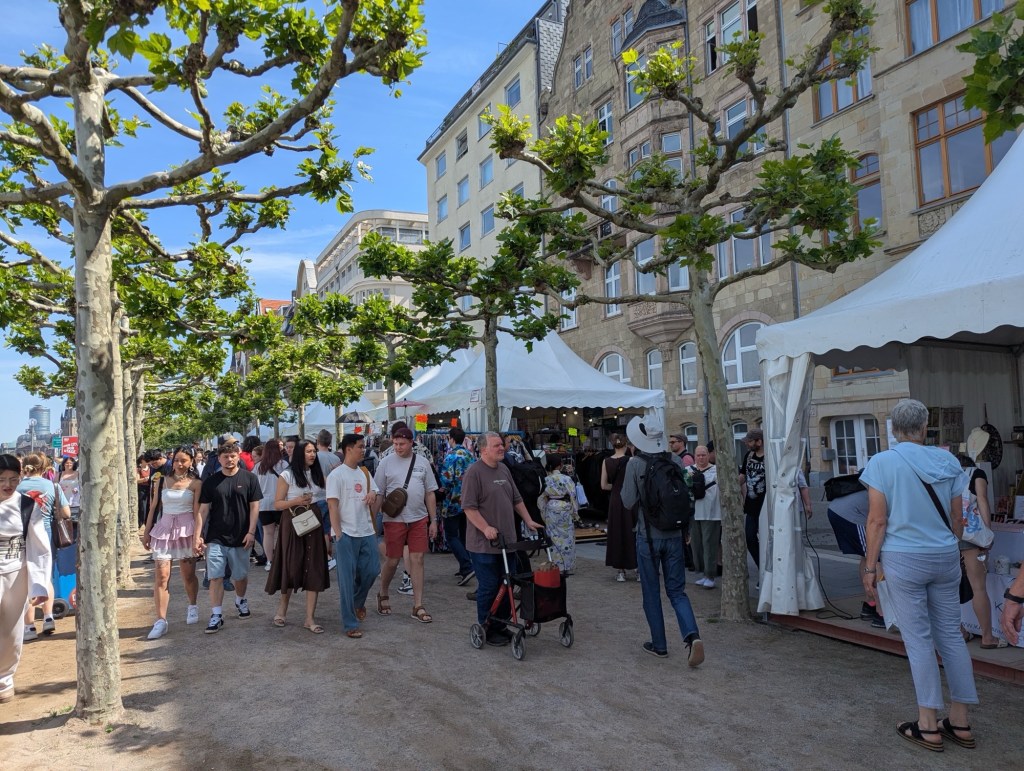
As you move towards the Rhine promenade, the scale of the festival gradually reveals itself. The riverfront transforms into a sequence of cultural zones stretching through central Düsseldorf. Temporary stages host traditional performances while nearby areas focus on contemporary Japanese music and anime culture. Food stalls line long sections of the promenade, filling the air with the smell of grilled meat, soy sauce and fried noodles.

One of the most remarkable things about Japan Tag is how naturally different aspects of Japanese culture coexist. A traditional shamisen performance may be taking place only metres away from a crowd dancing to J-Pop.

Families watch martial arts demonstrations while nearby groups of cosplayers gather for photographs. The festival works because it reflects modern Japan with traditional culture existing comfortably beside modern pop culture rather than competing with it.
Japanese Food
By midday, the festival reaches full intensity. The queues can become lengthy. Popular ramen restaurants in Little Tokyo often develop waiting times of more than an hour, while riverside food stalls remain constantly crowded throughout the afternoon. Yet food is central to the experience.

The smell of yakisoba drifts through the crowds while trays of karaage disappear almost instantly from busy stalls. Fresh takoyaki sizzles beside grills cooking skewers of chicken and seafood. Matcha desserts, mochi and Japanese cheesecakes appear everywhere. The city feels less like a festival venue and more like an enormous street celebration.
The Cosplay Culture

By afternoon, Japan Tag becomes one of the largest cosplay gatherings in Europe. Entire groups dressed as anime and video game characters move through the city while photographers line sections of the promenade asking politely for portraits. Parks, bridges and staircases all become improvised photo studios.

What makes the atmosphere special is how accepted and integrated cosplay feels within the wider festival. Traditional cultural performances, families with children, Japanese business visitors and anime fans all share the same spaces naturally.

You might spend twenty minutes watching a precise martial arts demonstration before turning a corner and finding a spontaneous anime dance performance surrounded by cheering crowds.
The Evening Transition

As daylight softens, Düsseldorf begins changing mood. The intense movement of the afternoon slows slightly as people start choosing positions for the evening fireworks. Groups sit beside the Rhine eating takeaway food while music drifts from stages further along the promenade. Beer gardens become packed. The golden evening light reflects across the river while boats move slowly through the centre of the city. Crossing bridges, listening to distant taiko drums and watching thousands of people gradually gathering beside the river creates an atmosphere unlike almost any other European festival.
Japanese Fireworks at Japan Day Düsseldorf
After dark, the city reaches maximum intensity. Public transport becomes extremely crowded as even more visitors arrive for the fireworks display. Streets around the Rhine fill almost completely. Yet despite the enormous crowds, the atmosphere is remarkably calm and good natured.

The Japanese fireworks display is the grand finale of Japan Tag Düsseldorf and differs greatly from typical firework shows. While European displays often focus on rapid explosions, loud effects and dense choreography, Japanese fireworks, known as hanabi (“fire flowers”) are designed as a form of artistic performance.

Japanese fireworks emphasise precision, symmetry and elegance. Each shell is carefully handcrafted to create perfectly shaped patterns, slow moving golden cascades and delicate colour changes. The pacing is also very different: instead of constant explosions, there are intentional pauses so the audience can fully appreciate each individual effect.

What makes the Düsseldorf display especially unique is that Japanese pyrotechnic experts travel from Japan every year to design and oversee the show. They work together with German fireworks teams to recreate an authentic Japanese-style performance over the Rhine. This collaboration reflects Düsseldorf’s close connection with Japan and its large Japanese community, making the fireworks not only an entertainment spectacle but also a symbol of German–Japanese friendship. For around twenty five minutes, the entire city watches the sky. Gold cascades spread across the river while enormous circular blooms reflect in the water below. The crowd repeatedly falls silent before erupting into applause as each sequence finishes. It was a mesmerising experience and one that will live with me for ever.
Practical Advice

If possible, staying somewhere central makes the entire experience significantly easier. Hotels around the Hauptbahnhof, Altstadt and Medien Hafen allow visitors to walk back after the fireworks rather than struggling through crowded stations late at night. Comfortable shoes are essential because you will probably walk far more than expected. Japan Tag is experienced properly on foot, moving between Little Tokyo, the Rhine promenade and the various performance areas scattered across the city centre. Cash is also worth carrying because some food stalls and smaller vendors still prefer it despite Germany becoming increasingly card friendly. Most importantly, arrive early.
Final Thoughts
What made Japan Tag extraordinary is that it never felt artificial as Düsseldorf is home to a very large Japanese community with its own schools, businesses, supermarkets and restaurants. The festival has grown naturally from decades of cultural connection between Japan and the city itself.

For one weekend each year, Düsseldorf genuinely becomes Europe’s Little Japan so why not experience it for yourself in late May 2027 – I’m certain you would love every minute of the festivities just as much as we did.
We were guests of Visit Dusseldorf and as always, all views and opinions are entirely my own.
If you have enjoyed this post you may also like:
48 Hours in Hamburg: Exploring Germany’s Beautiful Port City


Leave a comment